Today I tried a new app that allows me to watch free movies called Popcorn Time. Originally, I was about to download a torrent of a movie from yts.am but apparently, I have not installed a torrent downloader on my laptop yet. I’m using Acer C720P Chromebook with the Deepin operating system.
My Chromebook drive is easily populated if I have to keep the movies in my SSD and it will take too much waiting if I have to wait for the torrent to be completely downloaded.
Luckily, I got my eyes on Popcorn Time and then installed it instead of my first intention when I opened the Deepin Store. No luck with Deepin Store, so I tried using:
sudo apt-get install popcorn-time
…in the Terminal. And it worked!
The setup process was easy, but I needed to go through the password setting twice (maybe it’s just me). It can also deal with torrents you already have. This is the video to explain how Popcorn Time looks:
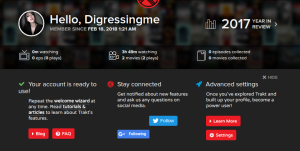
Popcorn Time can organize both the movies we’ve watched and our next movie list. We can also connect to trakt.tv to sync our movie list, review, etc.
I always prefer a quieter working atmosphere while listening to my favorite Megadeth songs. The point is there should be no other sound source other than the song I’m listening to. Sounds impossible? Apparently not. Because I got my way in order to silence Linux.Previously, I got this when I was still typing using the Samsung SM-P901 which until now has not succeeded I raised from death suspended. Obviously quiet, because like all tablets in general, P901 has no fan. Likewise, if I use a Chromebook that is also fanless. No sound interferes with my working atmosphere.
This concept is what I want to apply to my MacBook Pro mid-2010.
MacBook Pro is already eight years old, quite old. But with Apple’s constantly updating behavior (and unfortunately I keep trying), the work process gets heavier. For that reason, I then decided to install Deepin after impulsively removing all my Mac OSX partitions.
Deepin offers me everything I needed. That is a beautiful application and use, the installation process is not complicated, and of course, an appearance that is not shameful. We know that Mac OSX is superior because of this one (even for those who are really just users).
One thing that annoys me is … I feel annoyed because it turns out the MacBook Pro fan is becoming very noisy. And I think it’s really noisy and annoying.Luckily I found a solution that does not cost me a new routine.
I really mean it. No brainer here means that all of the processes are doable using some clicks or taps on your touchpad. No command line, no long tutorial with trials and errors. How comfortable is that? I’m now running Android apps on Linux and Chromebook myself.
I said no long tutorials, not no long story… so this is my story… 😀
Note: I’m running Deepin on MacBook Pro Mid 2010 and Chromebook Acer c720p.
I was installing Diablo 2 using Crossover, everything was fine (except the jumpscare when the installation finished) until it asked me for a CD key. Aw, come on… this is 2018, who still keep their old game CD keys. I know I don’t. And I also forgot where I got the CD key before, but I do remember that I keep it in my Evernote when I installed Diablo 2 on my Chromebook last night.
Not in a hurry, I decided to install Evernote as well on my Mac. Then I noticed a notification saying, “please update Google Play”.
Wait, Google Play? Is it even available here?
Still wondering, I’m trying my luck with sudo and tab in the Terminal. And yes… there they are. Some Android stuff. Then I did what I should’ve done first, checking the store. In Deepin, it’s called Deepin Store.
If you’re not running Deepin, try to go to its web store.
You will find some Android Apps, ready to install. Too bad, they’re just a few. But hey, I can play more games on my Mac and Chromebook running Deepin.
There are some new things happening with Deepin OS 15.5. We can get new Deepin tool and new Deepin updates. And now, we’re also going to learn more about Deepin OS and what makes it the best looking Linux distro, even better than my favorite elementary and Pop OS! You know how cool those two are, right?
Also, read about two of my other favorite Linux: elementary and Pop.
Let’s Start With New Deepin Tool
Installing Deepin and using it is very easy even for a no-brainer like me. Thank’s for its striking design and intuitive GUI which aims to provide an elegant, user-friendly and reliable operating system. And that even gets easier by the presence of new deepin repair tool, that we can use for, well… repairing deepin.
Let’s watch Deepin repair Tools in action:
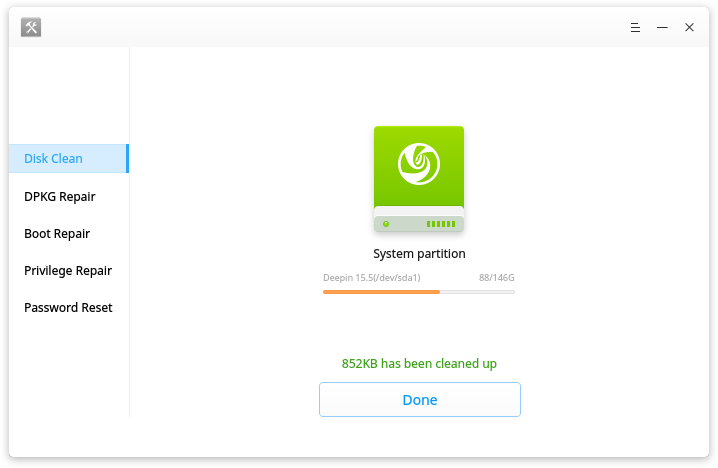
Deepin Repair is a tool to help users quickly fix some issues in deepin, including:
boot repairing
hard disk detecting
disk cleaning
DPKG repairing
privilege repairing
password reset.
Deepin Repair can run on both deepin Live system and the real environment. When you can’t find boot menu, have privilege error or forgot login password, you can’t enter deepin desktop. That’s when you need to go into a Live system at first to run Deepin Repair. Sounds hassle-free, right?
The development of Deepin started in 2004 at a fast rate by Wuhan Deepin Technology Co., Ltd, a Chinese company. Debian is used as Deepin base while its previous versions (pre-Deepin OS15.5) based on Ubuntu.
Its desktop environment called DDE (Deepin Desktop Environment) which is based on the Qt 5 toolkit. Its home-grown applications, like Deepin Software Centre, DMusic and DPlayer and now Deepin Repair are tailored to the “average” user.
If you happen to feel familiar with the description above, perhaps because you’ve used it before when it’s called Linux Deepin, Hiweed GNU/Linux. Ring a bell?
DTK to version 2.0.6.1-1 fixed the issue that no “Help” entry to view manual;
Deepin Boot Maker to version 2.0.4.3-1, fixed the issue that it cannot start in live system;
Deepin Repair to version 1.0.1-1, fixed the issue that no icon shows for the directory.
Let’s watch the video below:
It is amazing to see popular Linux sites come out with lists of “best distros” and keep missing on Deepin and Manjaro. It feels like they don’t want the public to know about those. In the case of deepin, as I already read, THIS by far is the best Linux distribution I have ever tried, Extremely user-friendly, beautifully design and countless options when it comes to utilities. My only complaint with it is that the software versions on the app-market always run little behind to pretty much everybody. I had every possible thing I can think of when I installed it, everything native and available on my first run. “CROSSOVER” is a life saver. – deepin user.
Download the latest deepin OS by sharing the link below:
Thank you for reading Deepin OS 15.5, I will keep the info about Deepin OS updated. Make sure you click the notification button on the lower right of your screen if you haven’t done so.
I’ve been using Ubuntu Studio since I decided to run Ubuntu along-side my MacOSX and Chrome OS (yes, that’s possible). Kinda late actually since everyone else in the world has tested Ubuntu at least once in their life. So, I guess I’m not too late to try this. Or may I say that I’m actually just at the right time to test a Linux myself? The Linux my friends use looked crappy and ugly. Sounds harsh, but you know this is true.
No matter how good you are in programming or you can even boil an egg with a command line… when I say ugly here, I mean by the look only.
After the first install, I am starting to fall in love with Linux and started my path of searching a better (looking) Linux since then:
These are the list of Linux distros I’ve tried, it’s ordered from the one I favor the most first:
I have also tried other flavors, you can find them using the search bar somewhere on this web. The first Linux I tried is Gallium before I walked my way installing Linux on my Chromebook using Crouton. No details will be covered here except for Ubuntu Studio, you can check the links on the list above to see more about the Linux version you want to know.
What Ubuntu Studio Offers
Ubuntu Studio is claimed to offer better multimedia production and experience. Started by changing its default theme including sounds. Optimized photo and video editing software, such as Gimp for photo editing and Pitivi for video editing. I haven’t tried any music editing software until now.
Ubuntu looks good too, just like it’s previous version (16) which is running alongside my Chrome OS right now. It’s not the best looking, but everything measured and placed just fine.
My Conclusion
So, if you are a first time Linux user like me, I’m suggesting to start with Ubuntu 17.10 or Elementary OS and Zorin OS for Mac user and Solus for Windows user. Again, for the sake of similar look only.
Last night, I had an idea to put Movies section to this website, then I tried to convert some of my collections. After some painful useless hours waiting for my video conversion processed by other application (because it failed), I decided to look for another alternative. That’s when I stumbled upon Miro Video Converter Free. Like the name already stated clearly, it’s free.
Not only free to use then ask you for money later like freemium, Miro calls itself a “donationware”, so we can choose how much we want to donate (or not).
Quicktime used to be so reliable for me to convert video files. But not later when I downloaded the more various video in different formats. And also, sometimes my clients send me their footage for me to put in their video. And they tend to send me the videos in the format I’ve never heard of.
Easy To Use
Miro Video Converter Free is easy to use. It lets you choose by devices selection rather than some coding um…codes. So you can comfortably choose the output according to your destination devices.
Here is how it looks:
The only cons I find is that it works rather slow. But perhaps that’s just my old MacBook Pro.



 bipolar is-popular_